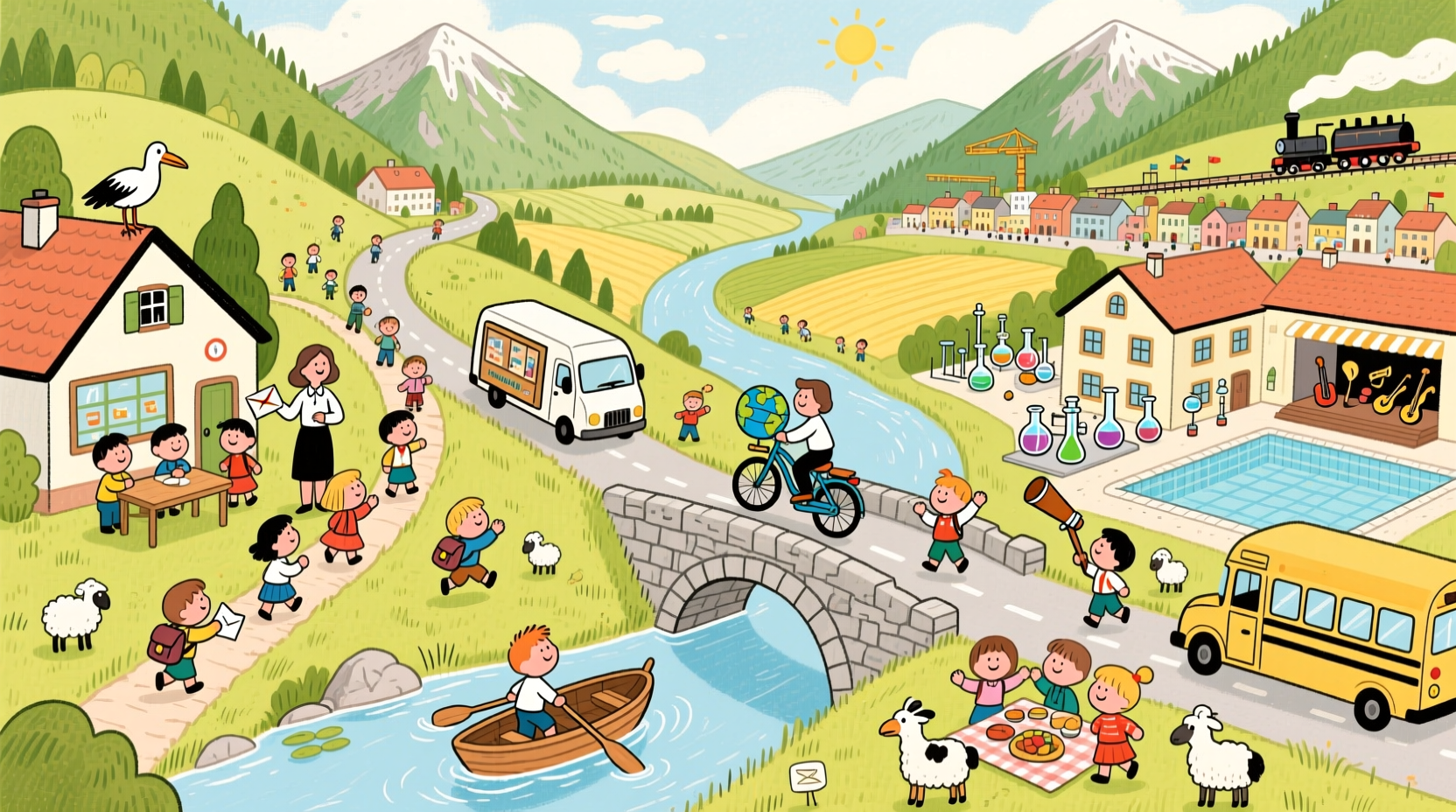
The Geography of Opportunity: How Where a Child Is Born Determines the Education They Receive
On the accident of the map, and why a postcode still predicts a future
The Lottery Nobody Chooses
Imagine two infants born on the same day with identical potential. One arrives in a wealthy district with well-funded schools, experienced teachers, and a community that assumes university is the default. The other is born a short drive away into a neighborhood of crowded classrooms, high teacher turnover, and an expectation that finishing school is an achievement in itself. Before either child has uttered a word, their educational fates have diverged sharply, and nothing about the difference reflects anything they did.
This is the geographic lottery, and almost no one chooses their ticket. The scale of it is easy to underestimate. The gap is not only between rich and poor countries, vast as that is, but between regions within a country, towns within a region, and streets within a town. A border on a map, drawn for reasons that have nothing to do with children, can separate one educational world from another. We speak of equal opportunity as a founding value, yet we have built systems in which the starting line moves enormously depending on the accident of address.
How Funding Follows the Map
In many systems the mechanism is brutally direct: schools are funded in part from local resources, so wealthy areas fund rich schools and poor areas fund poor ones. The places with the greatest needs are handed the smallest budgets, and the places that need help least receive the most. This is not a bug that slipped past reformers; it is the predictable result of tying a child’s education to the property values of the patch of ground they live on. The map becomes a funding formula, and the formula entrenches the inequality it grows from.
Even where central governments try to equalize spending, geography reasserts itself through subtler channels. Affluent areas attract and retain the strongest teachers, who can choose where to work. They draw in families who reinforce high expectations and supply the volunteer hours, the fundraising, and the political voice that quietly advantage a school. Money is only the visible part of the gap; behind it lies a whole ecology of advantage that clusters in some places and drains from others. Equalizing the budget, though necessary, never fully equalizes the opportunity, because so much of opportunity is not in the budget at all.
How Place Shapes a Child’s Education
The lottery: the strongest predictor of a child’s schooling is fixed at birth — where they happen to live.
Funding follows wealth: local financing means the neediest areas often get the smallest budgets, entrenching the gap.
Neighborhoods teach: expectations, peers, and surrounding adults shape a child below the level of formal instruction.
Gaps compound: small differences at age three grow large by ten and often unbridgeable by adolescence.
It’s not natural: borders, formulas, and teacher assignments are human choices — and can be remade.
The Neighborhood as a Teacher
A school does not educate a child in isolation; it works on a child already shaped by the place they live. The neighborhood is itself a kind of teacher, transmitting expectations about what is normal and possible. A child surrounded by adults who went to university, who read, who debate ideas at the dinner table, absorbs a sense that such a life is within reach. A child surrounded by the opposite absorbs something else, not because of any deficit in them but because environments teach, relentlessly and below the level of conscious instruction.
These neighborhood effects compound the formal ones. The same lesson lands differently in a context that reinforces it than in one that contradicts it. Peers matter enormously: a child whose friends treat school as pointless faces a daily headwind that no curriculum can fully offset. Researchers have found that moving a family to a higher-opportunity area, especially when children are young, can measurably change life outcomes — evidence that the place itself, and not merely the school within it, is doing a great deal of the work. Geography teaches even when no one is teaching.
Borders Between Worlds
Step back to the global scale and the geographic lottery becomes staggering. A child born in a stable, prosperous country can expect well over a decade of schooling, qualified teachers, and a realistic path to higher education. A child born into poverty or conflict elsewhere may receive a few years of overcrowded, under-resourced instruction, if any at all, and millions receive almost none. The difference in expected lifetime learning between the luckiest and unluckiest birthplaces is not a matter of degree; it is a matter of entire futures opened or foreclosed.
What makes this hard to confront is that it offends a belief most societies hold dear: that effort and ability should determine outcomes. The geographic lottery says otherwise. It says that the largest single factor in a child’s educational life was decided by forces utterly beyond their control before they could influence anything. This does not mean effort is irrelevant — within any given place it matters greatly — but it does mean that the playing field between places is so tilted that talk of a level contest is, at the global scale, something close to a comforting fiction.
| High-Opportunity Birthplace | Low-Opportunity Birthplace |
|---|---|
| Well-funded schools, low turnover | Crowded classrooms, high teacher turnover |
| University assumed as the default | Finishing school seen as an achievement |
| Neighborhood reinforces high expectations | Daily headwind from surrounding conditions |
| More resources where needs are smaller | Fewer resources where needs are greatest |
| Escape unnecessary; progress is ordinary | Success requires beating the odds |
The Myth of the Escape Hatch
Every system points to its exceptions: the child from the poor district who made it to the elite university, the village student who became a scientist. These stories are real and worth celebrating, but they are dangerous when mistaken for the rule. They prove that escape is possible, not that it is common, and they are often invoked precisely to avoid confronting how rare they are. The exception flatters the system by suggesting that anyone sufficiently determined can overcome geography, which quietly blames those who do not.
The honest reading of the exceptions is the opposite. The very fact that we tell these stories, that they stand out, reveals how unusual they are. If geography did not powerfully constrain opportunity, the child who rose from disadvantage would be unremarkable. That such journeys are celebrated as extraordinary is itself the strongest evidence of how steep the climb is. A fair system would not need heroic individual exceptions to deliver opportunity to the disadvantaged; it would deliver opportunity as a matter of course, and the exceptional escapes would simply become ordinary progress.
What Actually Narrows the Gap
The geographic lottery is not a law of nature, and some societies have softened it considerably. The interventions that work are unglamorous and consistent: funding formulas that send more money, not less, to the places with the greatest needs; deliberate policies to attract strong teachers to hard-to-staff schools; early-childhood programs that reach disadvantaged children before the gaps harden; and investment in the neighborhoods themselves, since a school cannot fully compensate for the conditions around it. None of this is mysterious. It is a matter of political will and sustained resources.
Crucially, the evidence suggests that reaching children early matters most, because geographic disadvantage accumulates. A gap that is small at age three becomes large by age ten and often unbridgeable by adolescence. Interventions that target the early years, and that combine school improvement with support for families and communities, achieve more than later remediation ever can. The lesson is that geography’s grip can be loosened, but only by acting deliberately and early against a force that, left alone, compounds quietly and relentlessly into adult inequality.
Why It Persists Anyway
If the remedies are known, why does the geography of opportunity endure? Part of the answer is that those with the power to change it are, by definition, the beneficiaries of the current arrangement. Families in high-opportunity areas have paid, in property prices and effort, for advantages they are reluctant to dilute. Equalizing opportunity can feel, to those at the top, like taking something away, and they tend to have the loudest political voice. The system reproduces itself partly because reforming it threatens the interests of the people best placed to resist.
There is also a quieter obstacle: the comfort of believing that outcomes are earned. Acknowledging the power of the geographic lottery means accepting that much of one’s own success, or one’s child’s, owes a great deal to luck of location rather than pure merit. That is an uncomfortable thought, and people resist it. The persistence of educational inequality is held in place not only by funding formulas but by a story societies tell themselves about fairness — a story the geography of opportunity stubbornly refuses to confirm.
Confronting the Accident of the Map
To take the geography of opportunity seriously is not to despair of effort or to excuse anyone from striving. It is to recognize that the contest we describe as open is, between places, profoundly unequal from the start, and that pretending otherwise mostly serves those who began ahead. A society that means what it says about equal opportunity would treat the accident of birthplace as a problem to be actively corrected rather than a fact to be quietly accepted behind the language of merit.
The encouraging truth is that the map is not fixed by nature. Borders, funding formulas, teacher assignments, and neighborhood conditions are all human choices, and human choices can be remade. Where societies have chosen to send the most resources to the places with the greatest needs, and to act early, the predictive power of the postcode has weakened. It will never vanish entirely, but it can be made far smaller than it is. Whether we do so is, in the end, a question not of knowledge but of will — and of whether we are willing to give up the comforting belief that where we ended up was simply what we deserved.
Frequently Asked Questions
Does where a child is born really matter that much?
Yes. Geography — country, region, neighborhood, even a school catchment boundary — is among the strongest predictors of the education a child receives, often outweighing individual talent. The effect operates through funding, teacher quality, peer expectations, and neighborhood conditions, and it is fixed before a child can influence anything.
Can a good school overcome a disadvantaged neighborhood?
Only partly. A strong school helps enormously, but it works on a child already shaped by their surroundings, and it cannot fully compensate for the conditions outside its walls. Evidence suggests that combining school improvement with support for families and neighborhoods, and acting early, achieves far more than school reform alone.
Why doesn’t equal funding fix the problem?
Because money is only the visible part of the gap. Affluent areas also attract the strongest teachers, reinforce high expectations, and supply political voice and volunteer support that no budget line captures. Equalizing spending is necessary but not sufficient; much of opportunity lives in conditions that funding formulas do not directly reach.
Treat the Postcode as a Problem, Not a Fact
The accident of where a child is born should not decide the education they receive, yet in most systems it largely does. The mechanisms — local funding, teacher sorting, neighborhood effects — are human choices, which means they can be unmade.
Societies that have sent the most resources to the places with the greatest needs, and acted early before gaps harden, have weakened the predictive power of the map. The knowledge exists. What remains is the will to give up the comforting belief that our starting line was simply earned.
Equal opportunity is meaningless if the starting line moves with the address.
This article is for general educational purposes and is not policy advice. For background, see educational inequality and global education data from UNESCO.